Civets & Mongooses · Bangladesh Field Dossier
Crab-eating Mongoose
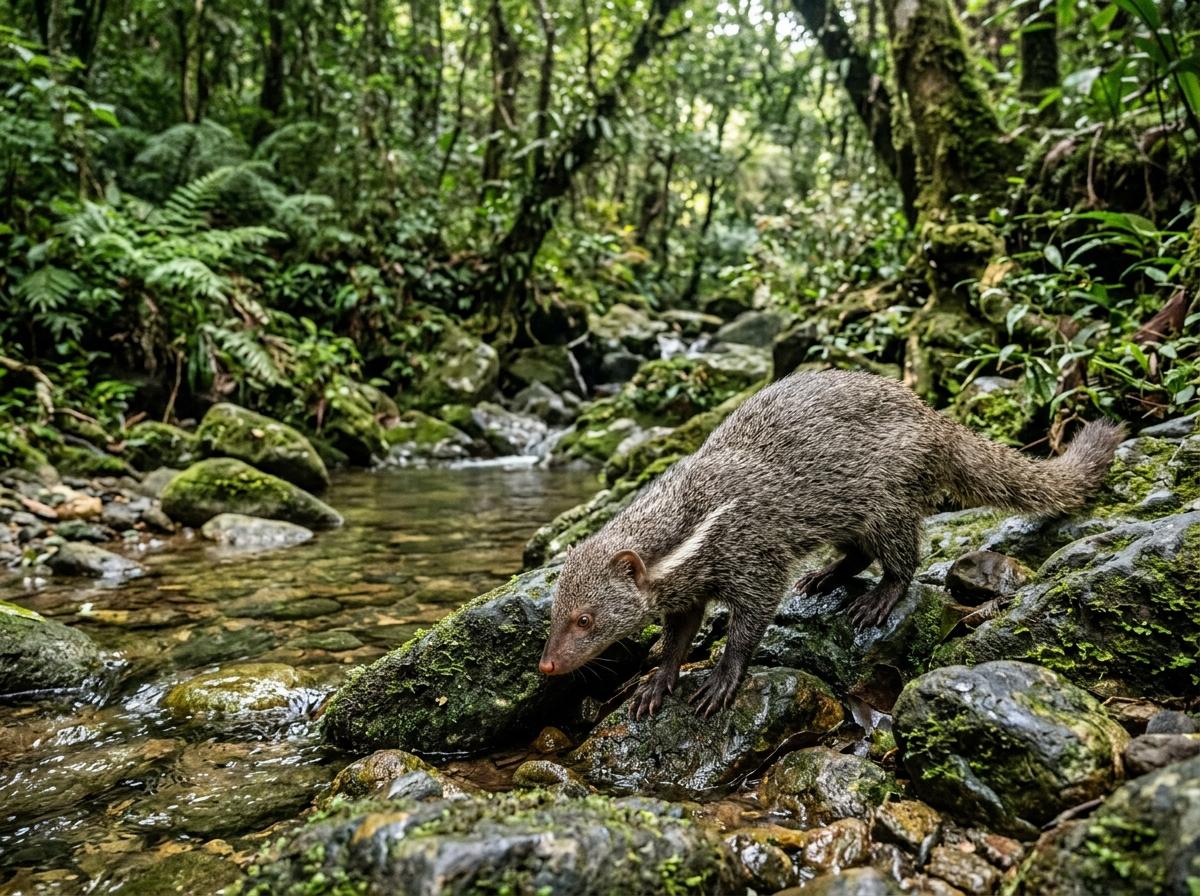
Bangladesh's largest mongoose—a sturdy, semi-aquatic forest specialist recognized instantly by the bold white stripe running from the mouth corners across each side of the neck.
- Global IUCN Red List
- Least Concern (LC)
- IUCN Bangladesh (2015)
- Near Threatened (NT)
- Ecological Guild & Activity
- Riparian Crustacean & Amphibian Predator · Diurnal & Crepuscular
- Typical Body Mass & Population
- 1.8–2.5 kg · Localized in Hill Streams
Habitat & Population Trend
Habitat: Forested Hill Streams, Riparian Pools & Damp Mixed Evergreen Forests
Trend: Decreasing
Primary Conservation Threats
Hill-stream sand/stone mining, stream drying & forest clearance
Ecological Role & Significance
Bio-indicator of clean, intact rocky hill-stream ecosystems in eastern Bangladesh.
Field Evidence & Conservation Assessment in Bangladesh
Formerly placed in genus Herpestes, taxonomic revisions classify Asian mongooses under Urva (Urva urva). Unlike village-edge mongooses, the Crab-eating Mongoose is tied closely to rocky forest streams inside protected parks like Lawachara, Rema-Kalenga, and Baraiyadhala, earning it Near Threatened status nationally in 2015.
Primary References & Checklists
- · IUCN Bangladesh (2015). Red List of Bangladesh, Volume 2: Mammals.
- · WildlifeScope & University of Chittagong Riparian Stream Ecology Context.
Sylhet, Chattogram & Chittagong Hill Tracts
Documented landscapes, reserve forests, and habitats linked to Crab-eating Mongoose (Urva urva):
- Lawachara National Park
- Satchari & Rema-Kalenga Sanctuaries
- Baraiyadhala & Kaptai Hill Streams
Crab-eating Mongoose Conservation FAQ (Bangladesh)
How do you recognize a Crab-eating Mongoose immediately in the field?
It is much bulkier and coarser-furred than village mongooses, with a crisp bright white stripe stretching back along both sides of its head and neck.
Why is the Crab-eating Mongoose dependent on protected national parks?
It needs unpolluted shaded hill streams rich in freshwater crabs, frogs, and stream insects—habitats preserved primarily inside eastern reserve forests and parks.
Related Family Herpestidae in Bangladesh