Mustelids · Bangladesh Field Dossier
Yellow-throated Marten
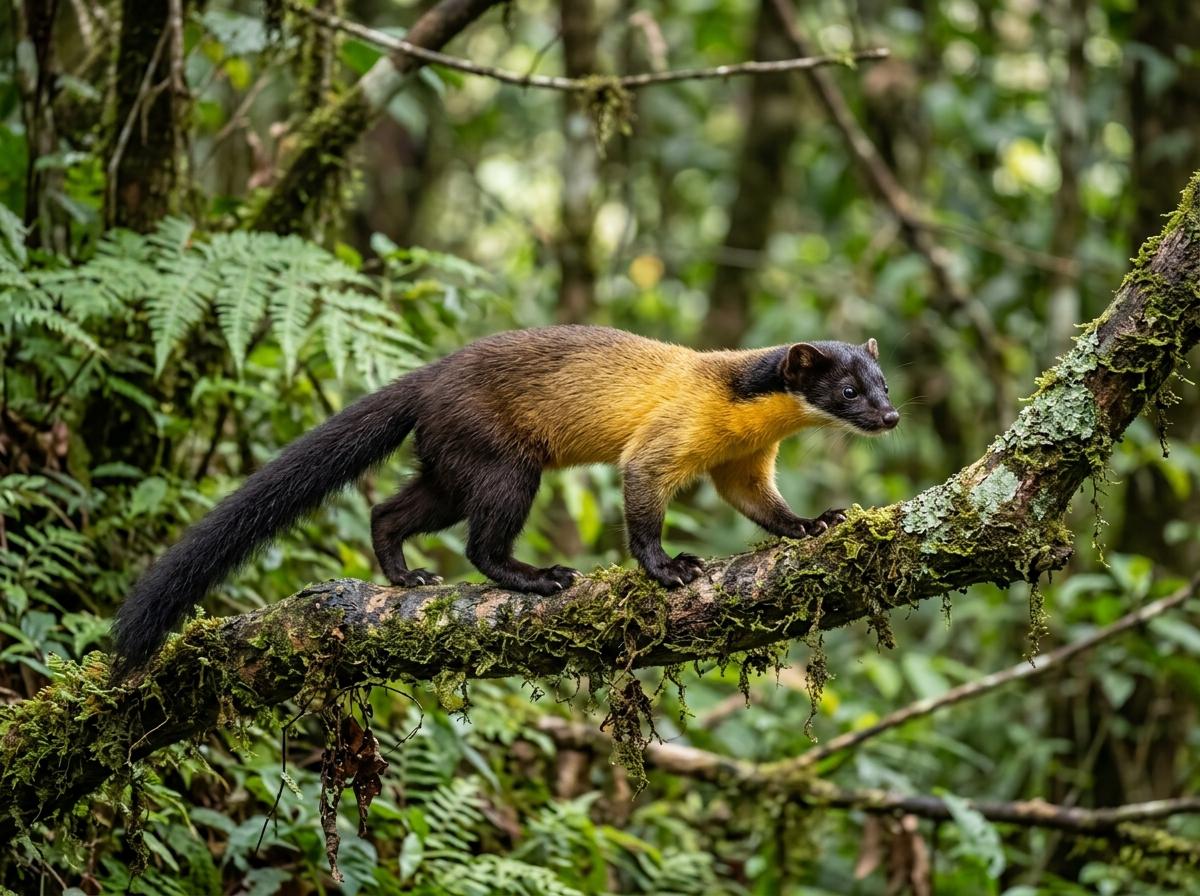
A vibrant diurnal forest mustelid with a glossy dark cap and long balancing tail contrasted by a bright golden-amber throat and chest.
- Global IUCN Red List
- Least Concern (LC)
- IUCN Bangladesh (2015)
- Vulnerable (VU)
- Ecological Guild & Activity
- Omnivore & Agile Predator (Fruit, Nectar, Birds & Squirrels) · Strictly Diurnal
- Typical Body Mass & Population
- 1.5–4 kg · Uncommon (Forest Dependent)
Habitat & Population Trend
Habitat: Canopy & Floor of Dense Hill and Mixed Evergreen Forests
Trend: Decreasing
Primary Conservation Threats
Deforestation, honey-hunter conflict & road fragmentation
Ecological Role & Significance
Agile daytime carnivore controlling forest squirrels and dispersing hill fruits.
Field Evidence & Conservation Assessment in Bangladesh
Assessed as Vulnerable in Bangladesh (IUCN 2015), Martes flavigula is frequently spotted bounding in pairs through Lawachara, Satchari, and Bandarban hill forests. It hunts both in high branches and on the forest floor, feeding on birds, rodents, lizards, wild figs, and honey.
Primary References & Checklists
- · IUCN Bangladesh (2015). Red List of Bangladesh, Volume 2: Mammals.
- · Northeastern Evergreen Forest Camera-Trap & Diurnal Transect Data.
Sylhet Mixed Evergreen Parks & Chittagong Hill Tracts
Documented landscapes, reserve forests, and habitats linked to Yellow-throated Marten (Martes flavigula):
- Lawachara National Park
- Rema-Kalenga Wildlife Sanctuary
- Satchari & Sangu-Matamuhuri Reserves
Yellow-throated Marten Conservation FAQ (Bangladesh)
When is the Yellow-throated Marten active in Bangladesh forests?
Unlike most shy forest carnivores, it is predominantly diurnal, foraging actively in pairs or small family groups from morning to late afternoon.
Which national parks hold Yellow-throated Martens in Bangladesh?
Confirmed populations inhabit Lawachara, Satchari, Rema-Kalenga, and eastern Chittagong Hill Tract evergreen reserves.
Related Family Mustelidae in Bangladesh