Mustelids · Bangladesh Field Dossier
Greater Hog Badger
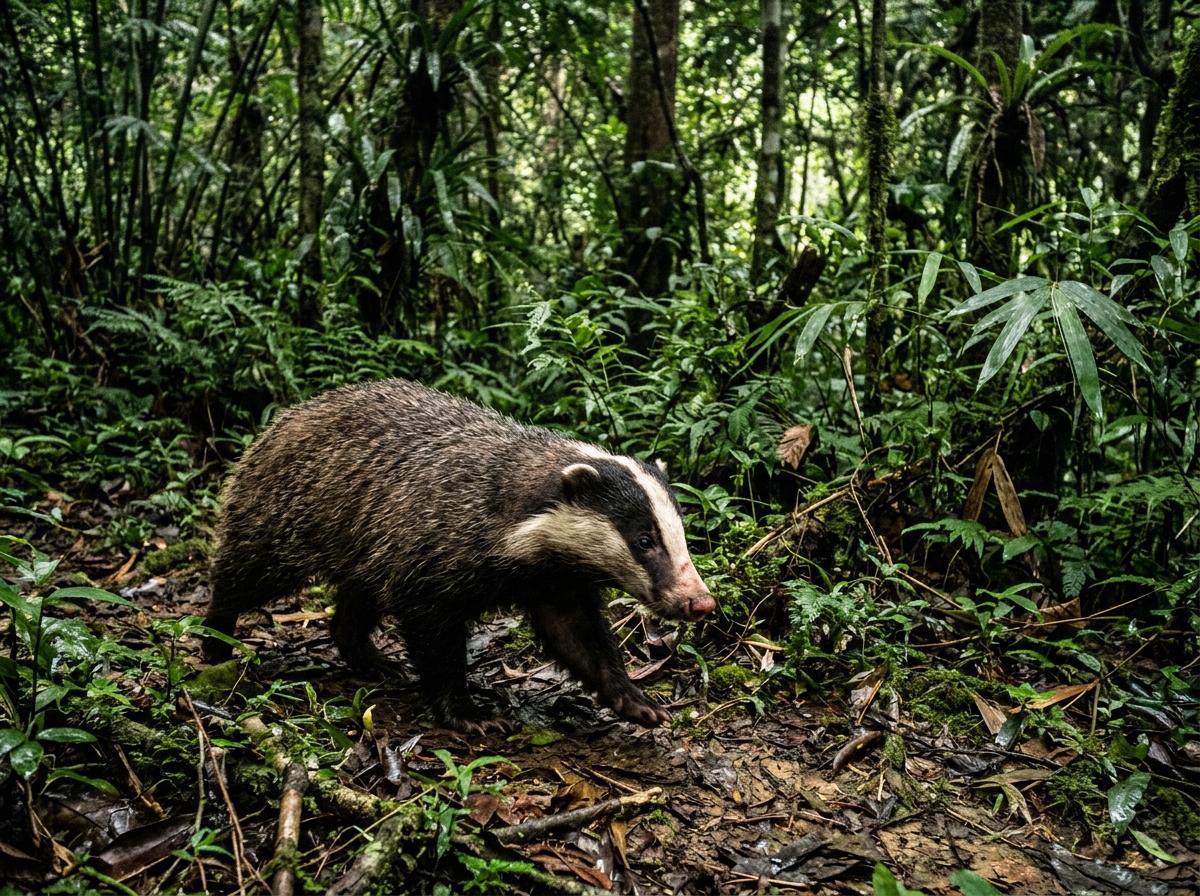
A heavy-bodied, pig-snouted forest badger with bold black-and-white facial stripes, long digging claws, and a pale throat collar.
- Global IUCN Red List
- Vulnerable (VU)
- IUCN Bangladesh (2015)
- Vulnerable (VU)
- Ecological Guild & Activity
- Fossorial Omnivore · Nocturnal & Crepuscular
- Typical Body Mass & Population
- 7–14 kg · Rare & Forest Restricted
Habitat & Population Trend
Habitat: Mixed Evergreen & Semi-Evergreen Hill Forests
Trend: Decreasing
Primary Conservation Threats
Hill forest degradation, bushmeat hunting & ground snares
Ecological Role & Significance
Soil-turning ecosystem engineer aerating hill-forest leaf litter while foraging.
Field Evidence & Conservation Assessment in Bangladesh
Confirmed via multiple remote camera-trap detections in Kassalong Reserve Forest (CHT) and Raghunandan Hill Reserve Forest (Habiganj), Arctonyx collaris is Bangladesh's verified hog badger species. Both IUCN Global and IUCN Bangladesh (2015) list it as Vulnerable (VU).
Primary References & Checklists
- · IUCN Bangladesh (2015). Red List of Bangladesh, Volume 2: Mammals.
- · Raghunandan & Kassalong Camera-Trap Confirmations of Arctonyx collaris.
Northeast (Sylhet) & Southeast (Chittagong Hill Tracts)
Documented landscapes, reserve forests, and habitats linked to Greater Hog Badger (Arctonyx collaris):
- Kassalong Reserve Forest
- Raghunandan Hill Reserve Forest
- Sangu-Matamuhuri Reserve Forest
Greater Hog Badger Conservation FAQ (Bangladesh)
Where has the Greater Hog Badger been photographed in Bangladesh?
Remote camera traps have documented Greater Hog Badgers in mixed evergreen forests including Kassalong Reserve in the Hill Tracts and Raghunandan Hill Reserve in Sylhet.
Why is it called a 'Hog Badger'?
It features a mobile, flat pink pig-like snout adapted for rooting through moist soil and leaf litter in search of worms, grubs, and roots.
Related Family Mustelidae in Bangladesh