Civets & Mongooses · Bangladesh Field Dossier
Large Indian Civet
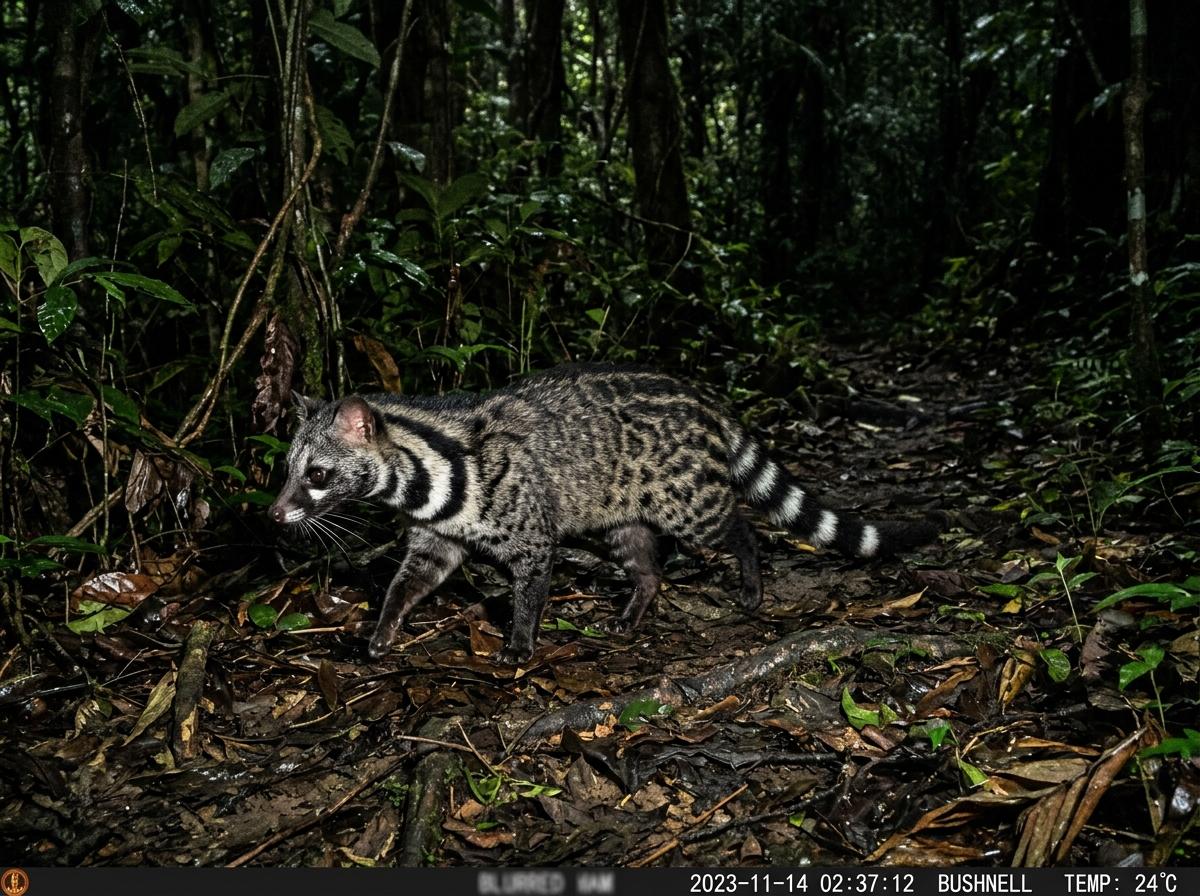
Bangladesh's largest true civet, marked by striking black-and-white throat gorgets, dark dorsal crest, and clearly banded tail.
- Global IUCN Red List
- Least Concern (LC)
- IUCN Bangladesh (2015)
- Near Threatened (NT)
- Ecological Guild & Activity
- Terrestrial Carnivore & Omnivore · Nocturnal
- Typical Body Mass & Population
- 5–11 kg · Uncommon & Declining Outside Forests
Habitat & Population Trend
Habitat: Mixed Evergreen Forests, Bamboo Groves & Riparian Scrub
Trend: Decreasing
Primary Conservation Threats
Persecution, bushmeat/civet-musk trapping, roadkill & scrub clearance
Ecological Role & Significance
Ground-dwelling predator regulating frogs, snakes, rodents, and nocturnal pests.
Field Evidence & Conservation Assessment in Bangladesh
Largely terrestrial compared to arboreal palm civets, Viverra zibetha occupies forest floors and dense bamboo groves across Sylhet, Chattogram, Dhaka, and Khulna divisions. IUCN Bangladesh (2015) upgraded its status to Near Threatened as rural persecution and linear highway infrastructure fragment once-common bushland.
Primary References & Checklists
- · IUCN Bangladesh (2015). Red List of Bangladesh, Volume 2: Mammals.
- · Satchari & Lawachara Camera-Trap Small Carnivore Assessments.
Forests, Scrublands & Rural Thickets Across Bangladesh
Documented landscapes, reserve forests, and habitats linked to Large Indian Civet (Viverra zibetha):
- Lawachara National Park
- Satchari National Park
- Rema-Kalenga & Madhupur National Parks
Large Indian Civet Conservation FAQ (Bangladesh)
How is a Large Indian Civet identified compared to a Fishing Cat?
It has an elongated pointed snout, crisp bold black-and-white stripes wrapping across the neck, and a long alternating black-and-white ringed tail—never a round cat face.
Are Large Indian Civets dangerous to livestock or people?
No. They are shy nocturnal animals feeding on rodents, frogs, crabs, insects, and fallen forest fruits, though unprotected free-range poultry can attract them.
Related Family Viverridae in Bangladesh