Civets & Mongooses · Bangladesh Field Dossier
Masked Palm Civet
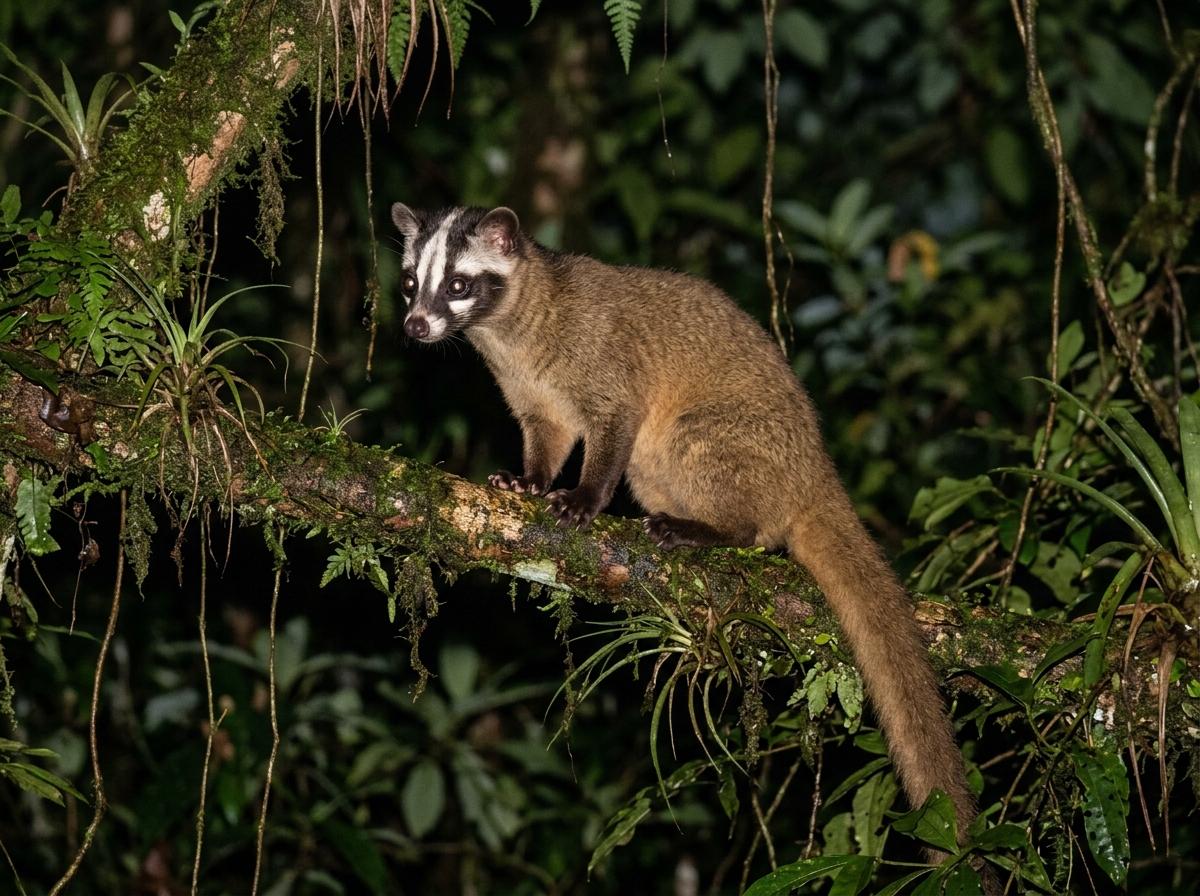
A sleek arboreal civet lacking spots on its uniform olive-brown coat, instantly set apart by a bold white facial stripe running from nose to crown.
- Global IUCN Red List
- Least Concern (LC)
- IUCN Bangladesh (2015)
- Vulnerable (VU)
- Ecological Guild & Activity
- Arboreal Frugivore & Omnivore · Nocturnal
- Typical Body Mass & Population
- 3.5–6 kg · Uncommon (Forest Restricted)
Habitat & Population Trend
Habitat: Dense Hill & Mixed Evergreen Forest Canopies
Trend: Decreasing
Primary Conservation Threats
Evergreen canopy logging, hunting & forest fragmentation
Ecological Role & Significance
Canopy-dependent seed disperser restricted to surviving eastern forest tracts.
Field Evidence & Conservation Assessment in Bangladesh
Unlike the adaptable Asian Palm Civet, Paguma larvata is tied closely to intact mixed-evergreen hill forests in Sylhet and Chattogram, earning it a Vulnerable (VU) regional ranking under IUCN Bangladesh (2015). Canopy bridges and undisturbed fruiting fig trees are vital for preventing isolation.
Primary References & Checklists
- · IUCN Bangladesh (2015). Red List of Bangladesh, Volume 2: Mammals.
- · Satchari & Lawachara Nocturnal Mammal Surveys.
Northeast (Sylhet) & Southeast (Chittagong Hill Tracts)
Documented landscapes, reserve forests, and habitats linked to Masked Palm Civet (Paguma larvata):
- Lawachara National Park
- Rema-Kalenga Wildlife Sanctuary
- Satchari National Park & Hill Tracts
Masked Palm Civet Conservation FAQ (Bangladesh)
How do you identify a Masked Palm Civet from an Asian Palm Civet?
The Masked Palm Civet has an unspotted, smooth tawny-brown body and a striking bright white stripe down the center of its snout paired with white cheek/eye patches.
Where is the Masked Palm Civet found in Bangladesh?
Unlike the countrywide Asian Palm Civet, the Masked Palm Civet is restricted mainly to evergreen hill forests in Sylhet, Chattogram, and the Chittagong Hill Tracts.
Related Family Viverridae in Bangladesh