Civets & Mongooses · Bangladesh Field Dossier
Small-toothed Palm Civet
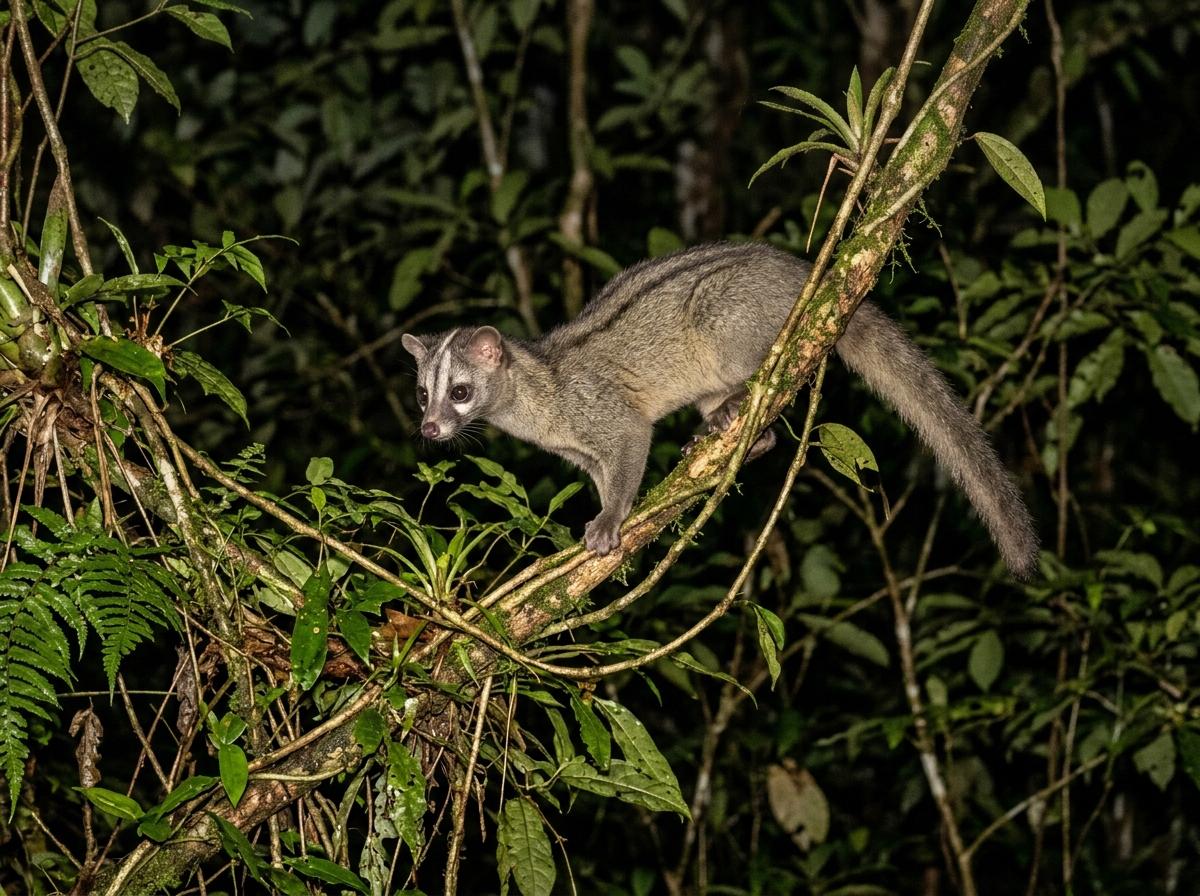
A slender, almost strictly tree-top viverrid marked by three faint dark stripes down its back and a thin white stripe down its nose.
- Global IUCN Red List
- Least Concern (LC)
- IUCN Bangladesh (2015)
- Data Deficient (DD)
- Ecological Guild & Activity
- Strict Arboreal Frugivore & Nectarivore · Strictly Nocturnal (High Canopy)
- Typical Body Mass & Population
- 2–2.5 kg · Unknown (Data Deficient)
Habitat & Population Trend
Habitat: High Canopy of Tall Tropical Evergreen Forests
Trend: Suspected Decreasing with Canopy Loss
Primary Conservation Threats
Selective logging of tall canopy trees & extreme survey scarcity
Ecological Role & Significance
High-canopy specialist rarely captured by ground camera traps.
Field Evidence & Conservation Assessment in Bangladesh
Listed as Data Deficient (DD) by IUCN Bangladesh (2015), Arctogalidia trivirgata is notoriously difficult to monitor because ground-level camera traps miss animals that spend nearly 100% of their lives high in contiguous vine-tangled canopies. Targeted arboreal canopy camera-trapping in Sylhet and CHT is needed to map true abundance.
Primary References & Checklists
- · IUCN Bangladesh (2015). Red List of Bangladesh, Volume 2: Mammals.
- · Arboreal Viverrid Records of Northeastern Bangladesh.
Northeast Evergreen Forests (Sylhet) & Chittagong Hill Tracts
Documented landscapes, reserve forests, and habitats linked to Small-toothed Palm Civet (Arctogalidia trivirgata):
- Rema-Kalenga Wildlife Sanctuary
- Lawachara National Park
- Sangu-Matamuhuri Forest Complex
Small-toothed Palm Civet Conservation FAQ (Bangladesh)
Why is the Small-toothed Palm Civet listed as Data Deficient in Bangladesh?
Because it spends almost its entire nocturnal life high in tall evergreen forest canopies, standard ground camera traps rarely photograph it, leaving large data gaps.
What are the key field marks of Arctogalidia trivirgata?
Look for three dark longitudinal stripes along a grey-brown back, a narrow pale streak up the muzzle, and an unbanded dusky tail.
Related Family Viverridae in Bangladesh